Thursday, July 17, 2008

Drive 55

Peter Aplebome, the terrific Our Towns columnist for the Times, is on the look-how-much-energy-we-waste beat. A few weeks ago he wrote about the appalling practice of some shops in Manhattan of keeping their doors open and air conditioning on during hot days (which seems to me to be akin to an appalling practice of supermarkets, namely keeping large refrigerator cases doorless and open).

Today, Appelbome writes about driving 55 miles per hour.

The experts say that fuel efficiency deteriorates radically at speeds above 60 miles per hour. Every 5 miles over that threshold is estimated to cost drivers, Mr. Warner said in his letter, “essentially an additional 30 cents per gallon in fuel costs.”

Yesterday I added a comment to a thread of comments on this post, in which I referred to this website, which says:

Aggressive driving (speeding, rapid acceleration and braking) wastes gas. It can lower your gas mileage by 33 percent at highway speeds and by 5 percent around town.

... While each vehicle reaches its optimal fuel economy at a different speed (or range of speeds), gas mileage usually decreases rapidly at speeds above 60 mph.

You can assume that each 5 mph you drive over 60 mph is like paying an additional $0.30 per gallon for gas....

That's based on gas costing $4.08 per gallon, by the way.

Appelbome goes on to quote a handful of people saying, essentially, that to get them to drive 55, you'd have to pry the steering wheel from their cold, dead fingers:

“It’s unrealistic,” said Darren Jacobs, an engineer from Grantham, N.H., who was driving home from Macungie, Pa. That is a trip of 412 miles, or 6 hours and 47 minutes, according to MapQuest. So assuming 25 miles per gallon, driving at 55 would likely cost 40 minutes and save at least $7. He figured he’d spend the money.

“It’s too slow,” Mr. Jacobs said. “It’s not the way we live. Everything is fast. We eat fast food. We have high-speed Internet. If you’re going from Point A to Point B you want to get there as soon as you can. I don’t think the solution is making us go slower. It’s getting tough on the greedy people who are profiting from this.”

Pete Boucheron, a retiree from Schenectady, N.Y., said, yeah, there’s some logic to 55, but it might have more appeal if prices got really high, say $6 or $7 a gallon. Gustavo Cardenas said he was for it — but then, he’s from Montreal.

Of course this is both baloney and true -- baloney in that all they have to do to change, is change; true in that as long as everyone else is driving 70, they will too.

I think a 55 mile an hour law probably would be a good thing (and of course the speed limit on a lot of roads still is 55 miles per hour).I also continue to believe that a pervasive and clever public service campaign that emphasizes both the amount of money you can save and the amount of greenhouse gases you can avoid emitting would be effective. It's worth a try.

Labels: ,

Tuesday, July 15, 2008

Long Island Sound Might Be Turning Into Chesapeake Bay Right Now, If Crab-Catching Fishermen Are To Be Believed

Not long after Rhode Island scientists reported that warmer waters are changing the species composition in southern New England's estuaries and coastal areas, presaging that we might be turning into Chesapeake Bay, the Boston Globe came down to Long Island Sound and heard that fishermen are talking about seeing and catching more blue crabs than ever, here.

Labels: , ,

Friday, July 11, 2008

55 MPH

I've been advocating (in my desultory way, here, here and here) that people drive 55 miles per hour (or as close to that as possible) as a way to cut down on greenhouse gas emissions. Here's a guy I disagree with on the issue (from the New Haven Register):

Greg Amy of Middletown, a member of the National Motorists Association, can't imagine Connecticut drivers ambling along at 55 on a clear stretch of highway.

"People don't obey these artificial speed limits. ... All it's going to do is make criminals out of people driving safely to where they're going," he said.

While Amy said "nobody will dispute with you reasonably" that slower speeds save fuel, "people are not going to drive (55 mph) so ergo it doesn't work."

I love his reasoning: People won't drive 55 miles per hour because people won't drive 55 miles per hour.

Of course just because I think it's something we can achieve doesn't mean I think it's something that will be easy to achieve. But people have come close to giving up cigarettes because as a society we've been convinced that it's bad. We can do the same when it comes to driving slower as a way to cut greenhouse gasses.

By the way, don't forget to sign up for Chris Zurcher's Connecticut Environmental Headlines (which is where I found the Register story; Chris has been taking some days off lately, which makes it harder for me to blog, so if you sign up it will encourage him to keep going)>

Labels: ,

Wednesday, July 09, 2008

Jellyfish: Last Year There Were None, This Year They're Here Early

As Long Island Sound grows warmer in the future, one of the unfortunate results might be that its beaches will become less appealing for swimming because of jellyfish. University of Rhode Island scientists reported recently that the species composition in Rhode Island's waters has changed over 50 years because of warmer temperatures. They said southern New England's estuaries and coastal waters might be gradually becoming more like Chesapeake Bay.

People rarely swim in Chesapeake Bay, if my increasingly faulty memory is to be trusted, because there are too many jellies. And today there's a Stamford Advocate story about how swimmers are reporting that jellies have arrived earlier in the summer than usual.

Keep in mind though that it was just last year that observers were wondering why the Sound was relatively jellyfish-free until October (here and here).

Labels: ,

Friday, May 16, 2008

Slow Down

Gas is $4.17 a gallon in my neighborhood, which really is amazing. Unfortunately there's not a whole lot I can do to drive less. I drive to and from work, a round trip of 24 miles, occasionally have to leave the office for meetings or field work, and then on weekends do what every suburban parent does -- drive my kids around. I drive a 1997 Subaru with 112,000 miles that gets a bit over 20 miles to the gallon, not a great gas-saver but not a hog either.

I saw a link on Chris Zurcher's headlines blog about how much gas you can save if you simply drive more slowly:

The Union of Concerned Scientists tells us that dropping from 70 to 60 mph improves fuel efficiency by an average of 17.2 percent. Dropping from 75 to 55 improves fuel efficiency by 30.6 percent!

Put another way, in a family sedan, every 10 mph you drive over 60 is like paying 54 cents per gallon more for gas you bought at $3.25 a gallon. (4) That extra cost is even higher for big SUVs and other less-efficient vehicles.

And the time you save by going easy on the accelerator may not add up to as much as you thought. On a 300-mile trip, driving 65 instead of 70 mph would cost you only 20 minutes -- but save money and spew less carbon.

That reminded me of my brilliant idea from January (here and here): State departments of transportation should begin campaigns to persuade drivers to slow down. One way to get the message across is to use those flashing signs that tell you when there's a traffic jam or roadwork ahead. If there are no problems to tell us about, put them toanother use: Flash a message that says, "Slow down to save gas and fight climate change. Driving 55 can save up to 30 percent."

Labels: ,

Friday, February 29, 2008

Action (or at Least Talk) on Climate Change

There are signs that some people are taking global warming seriously (whether they are the right people and enough of them is a question for another time). Fifty people, for example, went out in the cold the other night in Old Saybrook to participate in a discussion of the effects of climate change on the coast of Connecticut, here.

I'm rarely impressed by conferences or public meetings, but I was impressed by the one Westchester County put together on Tuesday to unveil a comprehensive climate change action plan (which our friend and longtime Long Island Sound activist Robert Funicello had a big hand in preparing). They were expecting 250 people and more than 400 showed up. I've been around environmentalists in Westchester for 25 years and when I go to a meeting I recognize a lot of people. That certainly was the case on Tuesday. Even better was that there were so many people I did not recognize. The county's action plan is here.

Labels:

Tuesday, February 05, 2008

More Clotheslines, Please

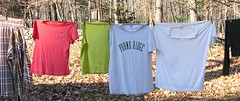
After you do your part to control global climate change by slowing down on the highway, you can do even more by hanging your laundry out to dry. According to this editorial...

Clothes dryers account for 6 to 10 percent of household energy use and emit up to a ton of carbon dioxide each year.

laundry

But some homeowners associations have a no-clotheslines rule, apparently, so as not to offend the aesthetic sensibilities of the neighborhood. Personally I like the way laundry looks on the line, but that may be because of my age and the era I grew up in.


In Connecticut, meanwhile …

The Sierra Club and others are proposing a bill for the upcoming legislative session that would prohibit restrictions on the use of clotheslines. Such "right to dry" laws are being proposed in many states, and have been passed in a few.

Slow down and hang your clothes outside.What’s next? Forsake your leaf blower for a rake? Not a bad idea either.

(The painting above is called Shadow Decoration, by Charles Courtney Curran; you can see it at the Frances Lehman Loeb Art Center, at Vassar; the photo is of my laundry.)

Labels:

Thursday, January 03, 2008

Let's See It In Lights: Slow Down to Reduce Your Carbon Footprint

Driving around during my Christmas vacation (often fruitlessly, but that’s another story), I got to thinking about all these new-ish signs on the highways that tell you in lights if there’s a traffic jam ahead or when construction is scheduled for the near future, and specifically I thought about how they can be used when there’s no traffic jam or construction work.

What prompted this were comments Bryan and Sam made to this post from last month, in which I linked to a Gristmill post that showed that trading in an SUV that gets 16 mpg for one that gets 23 mpg saves twice as much gas as trading in a car that gets 32 for a hybrid that gets 47. Bryan and Sam pointed out that if you really want to use less gas, you should slow down too.

Can people be persuaded to do so? Would they be more willing to drive slowly if they were reminded that by doing so they can help fight global climate change?

What if the highway signs occasionally said something like, “Slow down. Driving 55 instead of 65 reduces the carbon footprint of your trip by 15%.”

Or something (I made up the 15 percent but somebody smarter than me can figure out the real number).

I think some people will go for it. And the more people that go for it, the more conspicuous the non-compliers will be, which might result in a form of peer pressure.

I tried it one day after Christmas when my son and I went to see the Siberian tigers at the Beardsley Park Zoo, in Bridgeport (this was a couple of days after the tiger fatality in San Francisco, and we were mainly interested in looking at the huge beasts and imagining what we’d do if…). On the Merritt, I set the car’s cruise control at 55 (the speed limit, which of course nobody obeys). I don’t know how much gas I saved but I sure felt self-righteous, and the truth is, with all the slow-downs on the Merritt, we didn’t really lose any time by maxing-out at 55.

Note to the New York State Department of Transportation and the Connecticut Department of Transportation: You ought to try it.

Slow down. Driving 55 instead of 65 reduces the carbon footprint of your trip.

Labels: ,

Thursday, December 20, 2007

Saving Gas

Global climate change isn't particularly my topic here but nevertheless there's a post on Gristmill today that starts with the words, "This never fails to fascinate me," and indeed it fascinated and amazed me.

If we want to reduce gasoline use, we can make a huge gain by concentrating first on vehicles that get very low mileage. Obvious. The amazing thing is that low mileage vehicles don't have to be traded in for high mileage vehicles to get the huge gain; trading in an SUV that gets 16 mpg for one that gets 23 mpg saves twice as much gas as trading in a car that gets 32 for a hybrid that gets 47 (of course, trading in a 16 for a 42 would be even better). Read it
here and look at the graph. (Update: Read through the comments on Gristmill for more good stuff.)

Labels: ,

Tuesday, November 13, 2007

Global Warming and Ecological Changes in Narragansett Bay

A year and a half ago scientists who spoke at the Long Island Sound Citizen's Summit conference, in Bridgeport, outlined some of the ecological changes taking place in the Sound and linked them to global warming. The most dramatic change, perhaps, was the shift in species composition caused by rising water temperatures -- cold water animals, like lobster and winter flounder, were being replaced by warmer water species, like summer flounder.

Not surprisingly, similar changes are being observed in Narragansett Bay. One of the most interesting is that the end of winter phytoplankton bloom that provides some of the Bay's bottom-of-the-food web food no longer occurs (I described it in the Soundon page 120 of my book). Here's what the Boston Globe reports:

A late-winter phytoplankton bloom long formed the foundation of the bay's food web. As days got longer and sunlight increased, the bloom would grow to cover almost the entire 25-mile-long bay. By early spring, the bloom would die naturally, and organic debris would settle to the bay's bottom, where creatures such as worms would feed on it and in turn become meals for fish such as winter flounder.

In the 1980s, the winter bloom stopped growing as large, and by the late 1990s it was all but gone. In temperature-controlled tanks at URI, marine biologists figured out why: It is being eaten.

Tiny marine animals called zooplankton are normally sluggish eaters in the winter. But researchers found that even a 1.4-degree increase in water temperature caused them to be more active in the tanks and to eat more, curbing the size of the bloom. Today, a longstanding summer phytoplankton bloom has become a more important food source, but it mostly feeds migratory, warm-water fish species, such as scup and bay anchovies. Without a significant winter bloom, the cold-water fish may be missing their meal.

The Providence Journal, meanwhile, reports on the changes in the Bay, the rapidly changing scientific opinion about why, and the political and budget issues that are hampering cleanup attempts:

Rhode Island-based scientists are publishing a book summarizing the last 25 years of science concerning the Bay. A key finding is that parts of the Bay function so differently from other areas, an eco-functional zoning plan should be created to better manage the bays within the Bay.

“We have found that the only constant about Narragansett Bay is change — and we’re in a period of accelerating change,” says Barry A. Costa-Pierce, director of Rhode Island’s Sea Grant program and co-author with Alan Desbonnet of the new book, Science for Ecosystem-Based Management — Narragansett Bay in the 21st Century.

“This is one of the best-studied bays in the world, and some of the surprises we’re finding are globally important,” says Costa-Pierce. The book finds that the Bay suffers from such health issues as regions of low dissolved oxygen and “a preponderance of opportunistic and nuisance species — weeds if you will — in the upper regions of the Bay.”

Some of that science points to new and disturbing ecological changes on the bottom of the Bay that may be triggered by global warming. The discovery has caught the attention of scientists around the world.

The Globe story is here, the Journal story is here. Both are must-reads.

Labels: ,

Wednesday, October 17, 2007

First Frost and Global Warming

We haven’t had a frost yet (and we did not turn the heat on for the first time until Sunday evening, although on some cool nights we’ve had a fire in the fireplace). I’ve been thinking that it was unusual if not unprecedented to be frost-free this late into the fall -- another sign of global warming. For six or so years in the late 1990s I kept track of weather information – high and low temperatures, big storms, first frosts, etc. This morning I pulled out the notebooks in which I jotted down those records. It turns out that in 1995, we didn’t have a frost until October 18. I was under the impression that the first frost always hit in late September or early October, but this might be because the third week of September is when you have to start worrying about your tomatoes getting zapped – not that they will, but that they could.

Here are the first-frost dates from my notebook:

1994 – October 3

1995 – October 18

1996 -- October 4

1997 -- September 25

1998 -- September 24

1999 -- October 8

During those years we lived in New Canaan, on the Pound Ridge border, about 200 yards from a reservoir, which might have protected the immediate area from an early frost. In any case, a first frost during the third week of October isn’t that unusual. Of course the third week of October is half over and there’s no frost in sight yet, so who knows how long it will last. So maybe it is global warming; and since no one with any knowledge is claiming that we're just starting to feel the effects of global warming now, maybe the 1995 record should be attributed to it as well.

Labels: ,

Thursday, October 04, 2007

Hike to the Melting Glacier

Memories and anecdotes are unreliable as evidence. Nevertheless I've lived in this neighborhood for almost 20 years and can't recall a year in which we hadn't turned the heat on at least once by the first week of October. This year we haven't though. We haven't had a frost either and tomatoes are still ripening in the garden.

One of the great luxuries of my life is the trip to Switzerland we've taken in each of the last several Februarys, to ski in the Engadine. The overnight flight is brutal and by the time we get off, gather our luggage, buy train tickets, hop the commuter train to Zurich Hauptbahnhof, the regular train to Landquart and then finally the Rhaetia Bahn into the Engadine, I'm ready to sleep in my seat.

It's a good opportunity to do so because you get a few minutes to settle in and then the tracks duck into a long tunnel and travel through the dark for 15 minutes. On the other end, you're deep in the mountains, near Klosters. It's a scene of great beauty, Alpine meadows rising into mountains that get lost in the clouds, snow falling, skiers gliding past. We keep going to the end of the line, however, another 45 minutes on the train, and last year when we got there we skied in 50-degree weather for the whole week, the brown patches on the mountainsides growing noticeably larger as the days passed.

The glaciers are melting in Switzerland, of course. In Klosters they're trying to make the best of it, by promoting a mountain hike to view the effects of global warming:

Here, climate change serves as an occasion for a climate hike. The four-kilometer-long circular tour from the Silvretta hut high above Klosters to the glacier features 15 theme-posts proposing interesting tidbits on the glacier, the melting of the ice, alpinism, the local flora and fauna, and the influence of humans on the Alpine ecosystem.

The Global Warming Trail features 15 theme-posts describing the effects of climate change and giving suggestions as to how individuals may learn to respect the climate in their daily lives. Changes, which may already be observed, are also documented. In this manner, the consequences of climate change are both made visible and tangible. The circular route evolves on a simple trail set in a lovely landscape. The beauty of the trail is in itself a highlight. For further information www.silvrettahuette.ch

Labels:

Wednesday, July 11, 2007

Global Warming in the Northeast: Say Goodbye to the Sound's Lobsters

I've only skimmed it so far, but this report, from the Union of Concerned Scientists, says that because of global warming we can kiss Long Island Sound's lobster population goodbye by the middle of the century. (We'll also have a hard time finding a place to ski in the northeast, but that's a different kind of issue.)

Here's a long excerpt from the section about Connecticut:

Sea-level rise. Global warming affects sea levels by causing ocean water to expand as it warms, and by melting landbased ice. Under the higher-emissions scenario, global sea level is projected to rise between 10 inches and two feet by the end of the century (7 to 14 inches under the lower-emissions scenario). These projections do not account for the recent observed melting of the world’s major ice sheets—nor the potential for accelerated melting—and may therefore be conservative. However, even under these projections, Connecticut’s coast faces a substantial increase in the extent and frequency of coastal flooding, erosion, and property damage.

IMPACTS ON COASTAL COMMUNITIES

The coastal area of Connecticut is home to more than 2 million people—more than 60 percent of the state’s population. That number swells each summer as tourists flock to the state’s sandy beaches and shoreline communities. From critical infrastructure to waterfront homes to salt marshes, much of this coastline is exceptionally vulnerable to sea-level rise. Indeed, some major insurers have withdrawn coverage from thousands of homeowners in coastal areas across the Northeast in recent years.

Coastal flooding. Rising sea levels caused by global warming are projected to increase the frequency and severity of damaging storm surges and coastal flooding. What is now considered a once-in-a-century coastal flood in New London and Groton (on opposite banks of the Thames River) is expected, by late-century, to occur as frequently as once every 17 years on average under the higher-emissions scenario. Connecticut communities have a lengthy history of protecting themselves against the sea, but the extra stresses created by sea-level rise and more frequent and extensive flooding can be expected to greatly tax both new and aging infrastructure and threaten vulnerable communities across the state.

Shoreline change. Sea-level rise is expected to permanently inundate certain low-lying coastal areas and dramatically accelerate erosion, particularly on important barrier beaches such as Bluff Point and Long Beach. Continued sea-level rise will also threaten the state’s ecologically important salt marshes and estuaries (which serve as critical feeding ground for migrating waterfowl and other birds, and nursery habitat for important commercial fish). Connecticut policy makers will need to take steps to protect the state’s vulnerable populations and infrastructure, as well as wildlife and critical coastal wetlands. This includes public education, updating and enforcing building codes and land-use regulations, and working with the insurance industry to effectively protect property and people.

IMPACTS ON FISHERIES

Clambakes and lobster festivals are synonymous with summer in Connecticut. Unfortunately, the Long Island Sound lobster population, which has declined nearly 70 percent in recent years due largely to warmer waters, is expected to collapse entirely by mid-century as the maximum heatstress threshold for lobster is consistently exceeded under either emissions scenario.

The New York chapter provides essentially the same information on coastal impacts as the Connecticut chapter. Here's what the New York chapter has to say about fish and lobsters:

Rising ocean temperatures will affect New York’s commercial and sport fisheries. For example, lobsters, which cannot tolerate warm water, already live at the southern edge of their preferred temperature range in Long Island Sound. As temperatures rise, the Long Island Sound lobster fishery (which has yet to recover from the massive temperature-driven die-off of 1999) is likely to be lost by mid-century under either emissions scenario.

Newsday has this story up already, and the Times has this, which includes this paragraph:

Professor McCarthy said the two alternative futures laid out in the study, which was peer reviewed by other scientists before being released, are neither a worst-case nor a best-case scenario. Conditions could be even worse than described if emissions increase over the coming decades, he said. And they could be eased substantially by efforts just now being put into place.

Labels: , ,

eXTReMe Tracker