Friday, January 04, 2008

Birth of the Modern -- Our New Blog

Regular readers and regular Googlers know that I occasionally veer off and write about things besides Long Island Sound and the environment, most frequently modern houses. I've always thought it was a juxtaposition that didn't make much sense; and it also effectively excluded my wife, Gina, from participating, and she knows far more about modern things that I do.

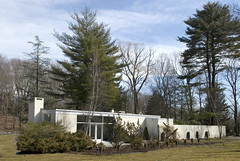
So we did what anybody in our predicament would do -- we started a new blog, called, simply enough, Modern. As of now there's only one introductory post but henceforth all of my modern house posts will be there, and a lot of new posts from Gina too, I hope.

So if you're interested in modern houses, the Harvard Five, New Canaan's modern house day, Philip Johnson and the Alice Ball House, Marcel Breuer, Landis Gores, Eliot Noyes, John Johansen, Edward Durell Stone, the Glass House, the house in Pound Ridge that Moore and Hutchins designed (and which we live in), and a lot of other modern things, stop by often. It's right here.

And for a while anyway I'll cross-post my modern house stuff here, for those readers who don't catch on right away.

Labels: , , , ,

Friday, December 14, 2007

Revolver, by Richard Foster, Philip Johnson's Collaborator


For fans of modern houses,
this one is interesting, to say the least: a revolving house, on a pedestal, with a view of the suburban countryside in Wilton, Connecticut. It was built by Richard Foster, who worked on a lot of projects with Philip Johnson. Foster in fact lived there until his death, in 2002.

[Read 'Modern,' our new blog about mid-century modern houses, here.]

Labels:

Friday, November 30, 2007

National Trust for Historic Preservation Highlights Philip Johnson's Endangered Ball House

[Read 'Modern,' our new Modern House blog, here.]

I never got around to linking to two
stories in local New Canaan papers about the public hearing on the application to tear down the Alice Ball House, which Philip Johnson designed. No big deal though because the National Trust for Historic Preservation web journal, Preservation Online, has an article up today that's better than what I would have done on this blog.

alice ball demolition notice 11/8/07

There's more than one issue here but this is one of the key ones:

Although the Connecticut Trust's Web site promotes selling the Ball House, no takers have emerged. Christopher Wigren, Higgins' deputy director and an architectural historian, characterizes this as a case where the home's inherent simplicity may actually work against it.

"People in a position to pay $3 million for a house want more than a galley kitchen," Wigren says. But, he adds, the home is a treasure for the right buyer.

"These houses were not designed to be flashy. It was a conscious simplification of life," he says.

And here's some background:

Earlier this year, the National Trust, in partnership with the New Canaan Historical Society and supported by the Connecticut Trust for Historic Preservation and the Connecticut Commission on Culture and Tourism, launched a town-wide survey of new Canaan's modern residences, outbuildings and landscapes. Why New Canaan?

"The decision to focus our efforts and resource sin New Canaan was based on the belief that New Canaan has one of the most important collections of modern residences in the United States," wrote National Trust President Richard Moe in a Nov. 14 letter to the chair of the town's historical review commission. "Our work will ensure the placement of those resources based in New Canaan in their proper national and international context and elevate the public's awareness of the importance of them to prevent senseless demolitions."

Another of Johnson's champions, architect Richard Bergman, says the trend toward knocking down older, architecturally significant homes not protected by historic designations is increasing.

"A building lot in New Canaan is worth $2 million from the get-go," Bergman says. He believes the Ball House should be preserved, but that the current owner has priced it so high it will be difficult to find a buyer. "I like the house; I could live in it myself," Bergman says.

Bergman, by the way, lives in a beautiful Greek Revival House near the train station that was the home of Maxwell Perkins, the Scribner's editor who edited Hemingway, Fitzgerald, Thomas Wolfe and others.

Here's the Preservation Online story.

Philip Johnson's Alice Ball House

Labels: , , ,

Wednesday, November 14, 2007

Public Hearing on the Application to Demolish the Alice Ball House

[Read 'Modern,' our new Modern House blog, here.]

New Canaan will hold a public hearing tomorrow evening -- that is, Thursday, November 15 -- on Cristina Ross's application to demolish Philip Johnson's Alice Ball House. It's at 7:30 p.m. in the Douglas Room at the Lapham Community Center at Waveny. The National Trust for Historic Preservation folks at the
Glass House have been trying to rally the anti-demolition troops, and I guess in this case they're entitled to throw stones, figuratively at least.

There's background, here and here.

alice ball demolition notice 11/8/07

Labels: , , ,

Thursday, November 08, 2007

Philip Johnson's Alice Ball House May Soon Be Demolished in Fight Between Its Owner and Town of New Canaan

[Read more about the Alice Ball House and other modern houses on 'Modern,' our new blog, here.]

For those who care about such things, New Canaan is as renowned for its large number of mid-century modern houses as it is for allowing a large number of mid-century modern houses to be destroyed and replaced by mcmansions. At least three of the Harvard Five architects -- Marcel Breuer, Eliot Noyes and John Johansen -- have had houses they designed razed. And I'm not sure anyone knows for sure how many modern houses in all have been demolished in New Canaan. Estimates of the number of modern houses that remain range from roughly 70 to 90.

If work by Breuer, Noyes and Johansen have all been destroyed, that leaves only two of the Harvard Five left -- Landis Gores and Philip Johnson.

And Johnson may soon join them. Cristina Ross, the owner of the Alice Ball House, which Johnson designed, has applied to the Town of New Canaan for a demolition permit. This comes after an extensive renovation, completed earlier this year (see here). (11 a.m. update: I drove past the Alice Ball house this morning and saw a big sign in front with the word "Demolition" printed on it, presumably a public notice that the owner has applied for a demolition permit. Generally the local government requires such notices to be posted and requires the owner/applicant to do so. Interesting that whoever erected it waited until after the Modern House Day tour.)

In other words, if Cristina Ross, an architect and developer, gets her demolition permit and if she proceeds, she would become the first person to demolish a house designed by Philip Johnson. Likewise, the Town of New Canaan would for the first time authorize such a destruction.

New Canaan would then be doubly famous -- for being the home of Johnson's landmark Glass House and for being the home of the oversized monstrosity that will no doubt replace the Alice Ball House.

Philip Johnson's Alice Ball House

The Connecticut Post had a good story about the issue last month, here. You'll see that there's lots of baloney from Ross and the Town about the other being unreasonable. This includes the Town's wetlands commission, by the way, which refuses to give Ross a permit to extend a driveway on the property across a wetland. I'm going to go out on a limb here and suggest the perhaps the wetlands commission is being a tad too intransigent. I've spent the last seven years of my life working on land preservation issues that usually involve wetlands protection. I know a lot about which wetlands are valuable and why, about how some wetlands are so valuable that nothing should be allowed to be built anywhere near them, and about how some wetlands don't have much value at all and can be encroached upon. I also know the Alice Ball House a bit (I've been in it once) and its property (I've been on it a couple of times and I drive past it regularly). If there's a wetland on that property worth saving to the extent that the Alice Ball House gets torn down, then I'm a modern architect.

The Alice Ball House has been on the market since early spring for about $3 million. Nine months does not seem like a lot of time for an expensive house to remain unsold. And you can easily see it -- its right on Oenoeke Ridge Road, near the intersection of Hemlock Hill Road (the Celanese House is two doors away).

If you're interested in buying it, give the William Raveis agency in New Canaan a buzz. In the meantime, Cristina Ross ought to back off and wait for a buyer. And the New Canaan wetlands comission out to think a bit more carefully about its mission.

Labels: , , ,

Wednesday, June 13, 2007

Bye-Bye to Another Modern House

[Read 'Modern,' our new blog about mid-century modern houses, here.]

When I get to work in the morning my wife e-mails me stories from the Times that I've missed because I spent too much time with the sports section. Remember the deal (
here) where two guys were going to buy a Paul Rudolph house on the beach in Rhode Island to save it from demolition and then move it to the Catskills? Well, no dice. The guys from the city prepared the land in the Catskills but when they went to get the house, they found that some of it had been changed beyond what they were willing to accept. So say bye-bye to another modern house.

Labels: ,

Wednesday, May 23, 2007

Modern Houses Saved, Destroyed, Bought, Sold

[Read 'Modern,' our new blog about mid-century modern houses, here.]

For an example of what could have happened to Paul Rudolph's Micheels House, in Westport, had the owner not been bent on destroying it, read this, about a Rudolph house on the beach in Rhode Island. From what I heard a few weeks ago, the owners made it available for free to anyone who wanted to pay to have it moved.

It was interesting, by the way, to see a quick reference to the death of modern domestic architecture in the Times Magazine over the weekend:

“Home buyers’ affair with modernistic design is over,” Witold Rybczynski declares in a new book, “Late Harvest,” on the creation of contemporary suburbs.

This is probably true. The only buyers nowadays who are interested enough in modernistic design to want to buy a modern house are well-off, if not wealthy, and they've turned modern houses into something to be collected, as I wrote here. That's not a bad thing, in and of itself, except that modern houses originated as efficiency houses -- easy to heat, easy to cool, easy to care for. They were "green" before anyone worried about houses being green.

One more modern house thought. Terry Teachout writes on his blog today:

After Fallingwater, Mies van der Rohe's Farnsworth House, built in 1951, is probably the best-known modern house in America, if not the world.

Seriously? Farnsworth House is better known than the Glass House? That's a subjective judgment, I realize, but I'm dubious.

Here's a really subjective scorecard: Google "Farnsworth House" and you get 110,000 hits; Google "Farnsworth House" + Mies and you get 43,700. Google "Glass House" and you get 1.29 million; Google "Glass House + Johnson and you get 283,000.

Labels: , ,

Thursday, May 17, 2007

New Canaan's Modern Houses and the National Register of Historic Places

[Read 'Modern,' our new blog about mid-century modern houses, here.]

The people who want to put New Canaan's modern houses on the National Register of Historic Places
(which I wrote about last Friday) say they've already been in touch with more than 80 homeowners and that, so far, the reaction has been good.

The project seems to be a collaboration among the Connecticut Commission on Culture and Tourism, the Connecticut Trust for Historic Preservation, the New Canaan Historical Society and the National Trust for Historic Preservation (which owns and operates Philip Johnson's Glass House). And there's an advisory committee of John Johansen, John Black Lee, Toshiko Mori, Theo Prudon and Robert A.M. Stern. (Johansen is the only survivor of the Harvard Five architects (Johnson, Breuer, Noyes and Gores were the others); John Black Lee designed a number of New Canaan moderns, including one of my favorites, on Chichester Road, which Toshiko Mori, the chair of the Department of Architecture at the Harvard Graduate School of Design, re-did a few years back (Lee also supervised the construction of my in-laws' house in Pound Ridge, although he didn't design it); Stern is the dean of the Yale School of Architecture; I don't know who Theo Prudon is, although I probably should).

Here's the idea behind the project, from the Glass House website:

The knowledge gained from this project is not only intended to shed light on the individual importance of this community in its greater influence outside of CT, but it is intended to inform other Modernist communities across the United States that wish to embark on similar studies. The recognition of mid-century Modern homes and their role as an asset within real estate investment is growing, however the formal recognition of this architecture is still necessary for a proactive approach to preservation. The thematic National Register Nomination of a number of these homes will serve this purpose.

I haven't heard about any modern houses in New Canaan being razed lately, which not long ago was a huge problem. I'm sure there are still threats, and I think the town government itself still takes a hands-off attitude about it, as if tear-downs were merely a function of the free market when in fact, with all the zoning regulations in New Canaan and elsewhere, real estate and development are almost completely under government control and tear-downs could be regulated too if the town thought it important enough.

Listing on the National Register in itself won't prevent tear downs. But it will be one more way to put encourage owners to preserve modern houses and, with any luck, discourage the spec developers from buying them and tearing them down. I think it's a terrific and very ambitious idea.

Which prompts this thought: while the list is being prepared for the National Register, someone ought to come up with a complementary list of developers who buy and tear down modern houses. Maybe they'd be less willing to do it if we make their names known (like this guy, in Westport).

Labels: , , , ,

eXTReMe Tracker