Friday, September 11, 2009

The Manatee is Revisiting Its Old Stomping Grounds

The manatee in Rhode Island can be identified by its scars as one that has been to RI before. People are feeding it though and state officials are saying that's a bad idea because it might discourage the animal from leaving in time to make it back south before the waters turn too cold for it to survive. And of course it's illegal to interfere with an endangered species.

Labels:

Wednesday, September 09, 2009

Manatee Alert

A manatee is hanging around Point Judith, Rhode Island -- supposedly the same one seen in or near Long Island Sound last week (which was news to me).

When was it that a manatee spent a lot of time up here? There was one in 2008 (it died in a truck on the way back to Florida) and another in 2006.

Labels:

Thursday, October 16, 2008

One Dead Manatee

The manatee that swam to New England and then couldn't find its way back south when the waers started to cool off died the other day on the truck ride to Florida. From the Boston Globe:

Cold stress syndrome in manatees is a series of physiological symptoms and diseases that can be triggered in cold water. Studies show that water that dips into the 60s can dampen manatees' metabolism, making them lose weight and weakening their immune system. In Sesuit Harbor last week, water temperatures hovered at 65 degrees, and Dennis's body temperature Saturday was almost 15 degrees below normal.

That's why wildlife rescue groups decided to catch Dennis, take him south to rehabilitate, and release him in the warm waters of his native habitat, Florida. But he died Sunday after a 27-hour journey by truck to a rehabilitation Center at SeaWorld in Orlando.

"If this animal had been caught sooner, the prognosis would have been better," said Bob Bonde, a biologist with the US Geological Survey in Florida who has studied manatees for 30 years. "I think in hindsight, with cold-stressed animals, it would be a good idea to get them to a facility locally before having them undergo transit."

The US Fish and Wildlife program rescues about 50 manatees a year, mostly from Florida's coastal waters, as winter approaches. Most survive, said Bonde, but they are not forced to make such a long trip.

Labels:

Tuesday, October 07, 2008

Manatees and Terrapins

Out near Cape Cod, scientists are trying to keep track of a manatee that has made its way north. Manatees are unusual but certainly not unheard of up here. Three years ago, one swam up the Hudson River and another (or maybe the same one -- I forget) was spotted in Rhode Island waters. The concern now, according to this story, is that the waters will get too cold for the Cap manatee, although why that should be an issue for a mammal -- as opposed to a cold-blodded sea turtle, for example -- isn't clear to me.

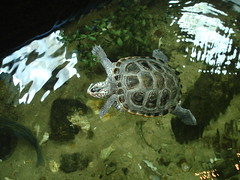
DSC00285 In Maryland, scientists are trying to keep diamond-backed terrapins from disappearing. Amazingly, there was a legal commercial harvest of terrapins in Maryland until as recently as last year. There's a good story about the situation here. Back in '03, the Times published a piece about the work Matt Draud, of LIU-C.W. Post, is doing to study Long Island Sound's terrapins, which I wrote about more briefly here. Track down Joseph Mitchell's piece, "Better than Monkey Glands," in Up in the Old Hotel, for a great account of terrapins as a culinary item.

Labels: ,

eXTReMe Tracker