Thursday, November 08, 2007

Philip Johnson's Alice Ball House May Soon Be Demolished in Fight Between Its Owner and Town of New Canaan

[Read more about the Alice Ball House and other modern houses on 'Modern,' our new blog, here.]

For those who care about such things, New Canaan is as renowned for its large number of mid-century modern houses as it is for allowing a large number of mid-century modern houses to be destroyed and replaced by mcmansions. At least three of the Harvard Five architects -- Marcel Breuer, Eliot Noyes and John Johansen -- have had houses they designed razed. And I'm not sure anyone knows for sure how many modern houses in all have been demolished in New Canaan. Estimates of the number of modern houses that remain range from roughly 70 to 90.

If work by Breuer, Noyes and Johansen have all been destroyed, that leaves only two of the Harvard Five left -- Landis Gores and Philip Johnson.

And Johnson may soon join them. Cristina Ross, the owner of the Alice Ball House, which Johnson designed, has applied to the Town of New Canaan for a demolition permit. This comes after an extensive renovation, completed earlier this year (see here). (11 a.m. update: I drove past the Alice Ball house this morning and saw a big sign in front with the word "Demolition" printed on it, presumably a public notice that the owner has applied for a demolition permit. Generally the local government requires such notices to be posted and requires the owner/applicant to do so. Interesting that whoever erected it waited until after the Modern House Day tour.)

In other words, if Cristina Ross, an architect and developer, gets her demolition permit and if she proceeds, she would become the first person to demolish a house designed by Philip Johnson. Likewise, the Town of New Canaan would for the first time authorize such a destruction.

New Canaan would then be doubly famous -- for being the home of Johnson's landmark Glass House and for being the home of the oversized monstrosity that will no doubt replace the Alice Ball House.
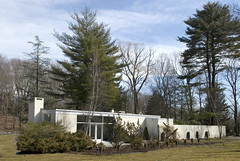
Philip Johnson's Alice Ball House

The Connecticut Post had a good story about the issue last month, here. You'll see that there's lots of baloney from Ross and the Town about the other being unreasonable. This includes the Town's wetlands commission, by the way, which refuses to give Ross a permit to extend a driveway on the property across a wetland. I'm going to go out on a limb here and suggest the perhaps the wetlands commission is being a tad too intransigent. I've spent the last seven years of my life working on land preservation issues that usually involve wetlands protection. I know a lot about which wetlands are valuable and why, about how some wetlands are so valuable that nothing should be allowed to be built anywhere near them, and about how some wetlands don't have much value at all and can be encroached upon. I also know the Alice Ball House a bit (I've been in it once) and its property (I've been on it a couple of times and I drive past it regularly). If there's a wetland on that property worth saving to the extent that the Alice Ball House gets torn down, then I'm a modern architect.

The Alice Ball House has been on the market since early spring for about $3 million. Nine months does not seem like a lot of time for an expensive house to remain unsold. And you can easily see it -- its right on Oenoeke Ridge Road, near the intersection of Hemlock Hill Road (the Celanese House is two doors away).

If you're interested in buying it, give the William Raveis agency in New Canaan a buzz. In the meantime, Cristina Ross ought to back off and wait for a buyer. And the New Canaan wetlands comission out to think a bit more carefully about its mission.

Labels: , , ,

Friday, March 23, 2007

Philip Johnson's Alice Ball House: Renovated and on the Market for $3 Million

[Read 'Modern,' our new Modern House blog, here.]

Of the four houses Philip Johnson designed in New Canaan, I’ve been in two, both during the New Canaan Historical Society’s Modern House Day in 2004 – the Boissonas House, which isn’t visible from the road, and the Alice Ball House, which is. It’s small – a cottage really – and a sort of off-white, muted yellowish color. You can find it on Oenoeke Ridge Road, which has become almost a monoculture of gargantuan houses that, like invasive species, have replaced older and more modest (though still large) houses. The Alice Ball House is opposite Hemlock Hill Road and a couple of houses down from Edward Durrell Stone’s Celanese House, which is being renovated.

I had been told (and I wrote on this blog a couple of times; you can find my Modern house posts on the lower right) that the Alice Ball House was owned by an architect who was converting it into a pool house that would be part of a larger property (with a larger house behind it) and that she was planning to build a wall for privacy between the road and the house Johnson designed. [Noon update: These minutes from the New Canaan zoning board indicate that as recently as a year ago the idea was still to turn it into a pool house.]

If that was ever the plan, it has changed. The owner-architect, Cristina Ross, has renovated and updated the house and has put it on the market. If you have $3 million and want a Modern trophy, it can be yours.

Christina sent me an e-mail yesterday saying that it was for sale and directing me to Pruddy Parris, the agent who is selling it (the listing, here, includes some good pictures). Here’s what Pruddy Parris told me:

The Alice Ball House by Philip Johnson is one of his favorites. He built his Glass House a couple of years prior and brought ideas from it to the Alice Ball House. This is his "little jewel.” … There are stone terraces, stone walls, a walled courtyard with its 'secret garden' on 2+ acres.

It has been completely restored leaving the original intact, and completely renovated where owners added on. There are new roofs, new electric wiring, new plumbing, new heating-humidifying system, new master bath, new guestroom and bath, new landscaping and driveway, interior all painted, newly finished lower level, and the exterior will be painted when weather improves.

New Canaan, of course, has become as well known as a place that tolerates the destruction of Modern houses as it is as a center of Modern houses. I don’t think any Johnson houses have been destroyed in New Canaan but houses by Breuer, Noyes, Johansen and others have fallen to make way for neo-colonial McMansions. But maybe times are changing. Cristina Ross wrote to me:

I am very proud to have saved and restored this house. We are looking for one great person who will treasure it.

Labels: , ,

Friday, November 30, 2007

National Trust for Historic Preservation Highlights Philip Johnson's Endangered Ball House

[Read 'Modern,' our new Modern House blog, here.]

I never got around to linking to two
stories in local New Canaan papers about the public hearing on the application to tear down the Alice Ball House, which Philip Johnson designed. No big deal though because the National Trust for Historic Preservation web journal, Preservation Online, has an article up today that's better than what I would have done on this blog.

alice ball demolition notice 11/8/07

There's more than one issue here but this is one of the key ones:

Although the Connecticut Trust's Web site promotes selling the Ball House, no takers have emerged. Christopher Wigren, Higgins' deputy director and an architectural historian, characterizes this as a case where the home's inherent simplicity may actually work against it.

"People in a position to pay $3 million for a house want more than a galley kitchen," Wigren says. But, he adds, the home is a treasure for the right buyer.

"These houses were not designed to be flashy. It was a conscious simplification of life," he says.

And here's some background:

Earlier this year, the National Trust, in partnership with the New Canaan Historical Society and supported by the Connecticut Trust for Historic Preservation and the Connecticut Commission on Culture and Tourism, launched a town-wide survey of new Canaan's modern residences, outbuildings and landscapes. Why New Canaan?

"The decision to focus our efforts and resource sin New Canaan was based on the belief that New Canaan has one of the most important collections of modern residences in the United States," wrote National Trust President Richard Moe in a Nov. 14 letter to the chair of the town's historical review commission. "Our work will ensure the placement of those resources based in New Canaan in their proper national and international context and elevate the public's awareness of the importance of them to prevent senseless demolitions."

Another of Johnson's champions, architect Richard Bergman, says the trend toward knocking down older, architecturally significant homes not protected by historic designations is increasing.

"A building lot in New Canaan is worth $2 million from the get-go," Bergman says. He believes the Ball House should be preserved, but that the current owner has priced it so high it will be difficult to find a buyer. "I like the house; I could live in it myself," Bergman says.

Bergman, by the way, lives in a beautiful Greek Revival House near the train station that was the home of Maxwell Perkins, the Scribner's editor who edited Hemingway, Fitzgerald, Thomas Wolfe and others.

Here's the Preservation Online story.

Philip Johnson's Alice Ball House

Labels: , , ,

Wednesday, November 14, 2007

Public Hearing on the Application to Demolish the Alice Ball House

[Read 'Modern,' our new Modern House blog, here.]

New Canaan will hold a public hearing tomorrow evening -- that is, Thursday, November 15 -- on Cristina Ross's application to demolish Philip Johnson's Alice Ball House. It's at 7:30 p.m. in the Douglas Room at the Lapham Community Center at Waveny. The National Trust for Historic Preservation folks at the
Glass House have been trying to rally the anti-demolition troops, and I guess in this case they're entitled to throw stones, figuratively at least.

There's background, here and here.

alice ball demolition notice 11/8/07

Labels: , , ,

Tuesday, March 27, 2007

The Alice Ball House ...

... Philip Johnson, architect. You can see it on Oenoeke Ridge Road, in New Canaan. [Read 'Modern,' our new Modern House blog, here.]

Philip Johnson's Alice Ball House

Labels: ,

Thursday, May 12, 2005

New Canaan, Connecticut

I have mixed feelings about New Canaan, Connecticut, where I lived for 13 years and where I made the mistake of not buying a house or a building lot, which I could have sold by now for a pile of money given the Himalayan heights of property values there and retired early on the profit to blog fulltime thereby filling the void caused by the appalling state of environmental reporting in the region.

But that’s not why I have mixed feelings.

I have mixed feelings because New Canaan has a downtown that is pleasant (although expensive) to visit, and it has houses and apartments close enough for people to walk to shop. There’s a pretty good bookstore and a good place to buy wine (Franco’s) and a Ralph Lauren shop that I like because Ralph himself is occasionally strolling along the sidewalk to and from the store and he’s much shorter than you’d think.

But beyond the business area, the town has gone through an appalling change. Fields and woods have been carved up into emerald subdivisions with 8,000 square foot houses and three acres of lawn on which immigrants from Central America spend more time (usually with hurricane-force leaf blowers) than the owners. Farmhouses of heart-aching charm have been bought up, torn down, and replaced with enormous houses designed to showcase their owners considerable wealth and execrable taste. The changes on Oenoke Ridge Road and White Oak Shade Road constitute a crime against local character.

New Canaan also has more than 70 classic, mid-century modern houses, designed by Philip Johnson, Marcel Breuer, Elliot Noyes and others. There had been more than 100 but, like the farmhouses, a good number - perhaps as many as 30 - have been razed and replaced. I’ve written elsewhere about why I think these modern houses are important, but mainly I just like the way they look. It’s a matter of taste, true, but it’s a big world and when it comes to domestic architecture there’s room for more than just faux-Colonials.

So I was pleased to hear this week that a Johnson and a Breuer that local aficionados had feared would be torn down apparently aren’t going to be. The Johnson house is called the Alice Ball House and it’s easily visible on Oenoke Ridge Road, across from Hemlock Hill Road. It’s tiny and would make a nice place for one person; apparently the new owner is going to convert it into a pool house adjacent to another house she wants to build nearby. The bad news is that she apparently will erect a wall between the house and the road, for privacy. So the Philip Johnson house will be saved but the opportunity to see it from the road might be soon lost.

The Alice Ball house was part of the New Canaan Historical Society’s Modern House Day tour last October. The Breuer house was not, but the tour guides made a point of driving past it and noting that it was for sale - and someone on the tour bought it, which is what the tour organizers secretly hoped for. This New York Times piece from last Sunday mentions that architect Toshiko Mori, who was one of the speakers at the MHD symposium, is updating a Breuer house in New Canaan. (The house that is pictured on the link is a John Black Lee house that Mori updated within the last decade or so; it's on Chichester Road in New Canaan and is worth driving past if you're interested in such things and are in the area.) I don’t know if the Breuer house that she is working on is the same Breuer house that the people on the tour bought, but in either case, it’s satisfying that not every person wealthy enough to buy a place in New Canaan is completely devoid of aesthetic sensibility.

Logo for the Modern House Day Tour and Symposium in New Canaan, CT
(This beautiful logo is by Gina Federico Graphic Design.)

Friday, November 09, 2007

The "Demolition" Sign in Front of Philip Johnson's Alice Ball House in New Canaan

alice ball demolition notice 11/8/07

[Read 'Modern,' our new modern house blog, here.]

As I said yesterday, presumably this is a public notice announcing that the owner has applied for a demolition permit. Generally the local government requires such notices to be posted and also requires the owner/applicant to do so. In this case it was erected just days after a couple of hundred modern house enthusiasts drove past it numerous times during the New Canaan Historical Society's Modern House Day tour.

Labels: , ,

Saturday, January 05, 2008

Protecting Modern Houses

There's a new post about how to protect your modern house and get a tax break, at our new modern house blog, Modern, here. In it I modestly suggest that the owner of the Alice Ball House in New Canaan ought to consider it.

Wednesday, January 03, 2007

Micheels Is Testifying Today At The Hearing To Determine The Fate Of Paul Rudolph's Micheels House in Westport

[Read 'Modern,' our new blog about mid-century modern houses, here.]

It's customary (although not an absolute rule) when talking about modern houses to name the house after the original owner. Thus the house in New Canaan on Oenoke Ridge Road that Philip Johnson designed is the Alice Ball House, and the house on Ponus Ridge Road that he designed is the Hodgson House (an exception to the rule is the house across the road, the Glass House, which Johnson designed for himself rather than for a fellow named Glass).

So following that custom, the Paul Rudolph house in Westport is known as the Micheels House, after Louis Micheels, for whom Rudolph designed the place in the 1970s. Micheels happens to be in court today, in Stamford, testifying as part of the hearing to decide if the fellow Micheels wants to sell to, David Waldman, will be allowed to tear the house down. The hearing started yesterday, and WestportNow is covering. The Connecticut Trust for Historic Preservation wants the judge to at least delay the demolition so it can complete an application to nominate the house for inclusion on the National Register of Historic Places and to give the state of Connecticut time to review the application. Micheels supposedly is coming down from the Boston area to say he doesn't want the house to be on the National Register.

Offhand, I know of three other modern houses on the National Register: the Hodgson House, Landis Gores's house on Cross Ridge Road in New Canaan, and the Mandel House, in Bedford Hills, designed by Edward Durrell Stone, which I have a picture of that I can't put my hands on at the moment.

[For more on the issue, see The Destruction of Paul Rudolph's Micheels House in the right hand column.]

Labels:

Friday, January 04, 2008

Birth of the Modern -- Our New Blog

Regular readers and regular Googlers know that I occasionally veer off and write about things besides Long Island Sound and the environment, most frequently modern houses. I've always thought it was a juxtaposition that didn't make much sense; and it also effectively excluded my wife, Gina, from participating, and she knows far more about modern things that I do.

So we did what anybody in our predicament would do -- we started a new blog, called, simply enough, Modern. As of now there's only one introductory post but henceforth all of my modern house posts will be there, and a lot of new posts from Gina too, I hope.

So if you're interested in modern houses, the Harvard Five, New Canaan's modern house day, Philip Johnson and the Alice Ball House, Marcel Breuer, Landis Gores, Eliot Noyes, John Johansen, Edward Durell Stone, the Glass House, the house in Pound Ridge that Moore and Hutchins designed (and which we live in), and a lot of other modern things, stop by often. It's right here.

And for a while anyway I'll cross-post my modern house stuff here, for those readers who don't catch on right away.

Labels: , , , ,

Thursday, May 11, 2006

Bunker in the Bay, "Long Island Sound," Endangered Species, and Modern Houses

Bunker, Mossbunker, Menhaden ... Big numbers of menhaden have made their way up Narragansett Bay to the Providence River in recent weeks. This has prompted the Baykeeper, John Torgan, to call for a commercial fishing ban:

The commercial seining of menhaden in Narragansett Bay for bait is controversial. Many recreational fishermen object to the presence of the large seine boats all the way up into the city of Providence, scattering if not decimating the schools and ruining the fishing. Many recreational fishers also object to the sight of bycatch such as striped bass and bluefish in the seine nets. Some commercial fishermen, some lobstermen, and the management agencies claim that there is no Bay-dependent stock, that they are not being overfished, and that the seiners support recreational fishing through bait shops.

Whether these seine boats are significantly depleting the Bay's populations is a matter of debate, but it seems reasonable that we should draw a line somewhere to limit the scope of the commercial netting even if just to protect the recreational fishery. My opinion is that the seiners are overfishing the Bay's stocks already. Drawing a line from the Conimicut light to the Nayatt light and prohibiting commercial seining north of that line would be a great start toward conservation and effective management.


Let's Celebrate ... The DC Birding Blog notes that today is Endangered Species day. That reminds me that someone once clicked on my blog after Googling “recipe for bog turtle soup,” which I found rather alarming. Endangered Species day also got me thinking about the threatened or endangered species I’ve seen (some of these have been de-listed since I’ve seen them): bald eagle, peregrine falcon, least tern, roseate tern, piping plover, loggerhead turtle and Kemp’s ridley turtle (the last two were dead, one at Marshlands Conservancy and one in a freezer at the now-defunct Okeanos Ocean Research Center in Hampton Bays). Bog turtles are on my short list of the threatened or endangered species I most want to see.

The Sound ... There’s a sonnet called “Long Island Sound,” by Emma Lazarus, and a bebop song called “Long Island Sound” by Stan Getz. And now the Long Island Music Hall of Fame has its Long Island Sound Award, presented to … a DJ. I guess you have to be a Long Islander to have heard of him.

Directions to Modern Houses ... A fellow in Massachusetts sent me an e-mail late last night:

My wife and I have a modernist home near Boston that we soon will be renovating – working, we hope, with Toshiko Mori. We’re hoping to visit New Canaan later in the month (most likely on the 24th) simply to admire as many modernist homes as we can see from afar (without disturbing the owners). Collectively, your blog posts are the closest thing I can find to a guide to New Canaan’s modernist homes. We’re grateful for the pointers. Can you suggest other resources for locating these homes? If there isn’t such a resource, are you able to tell us which streets or parts of New Canaan would be good to visit?

We share your concern about not disturbing the owners of these homes . . . and we share your love of them and desire to see them. We regularly see people slowly driving by our place (which is on Moose Hill Parkway in Sharon, MA, and was the family home of an MIT trained architect, John Newell, who knew and was influenced by Gropius).


That wasn’t the first time I’ve gotten a similar request, and so I’m posting my answer. All you fans of modern houses take note:

Chichester Road offers some good views from the car; Laurel Road is good too but the views aren’t quite as clear. Edward Durrell Stone’s Celanese House and Philip Johnson’s Alice Ball house are near each other on Oenoke Ridge Road. The Hodgson House is on Ponus Ridge, across the street from the Glass House. There are a couple of interesting houses on Lambert Road and near the Silver Hill rehab center. And you can see the Gores Pavilion at Irwin Park. There are plenty of others too. Don’t trespass.

Sunday, April 30, 2006

A Convergence of Modern Masters: Houses by Philip Johnson, Mies van der Rohe, and Edward Durrell Stone Are All For Sale

Every once in a while I get an e-mail from someone who has read the three or four things I’ve written about the famous Modern houses in New Canaan and nearby, asking how he or she can see them. I always say that the houses are private but that a lot of them are visible from the road, if you know what roads they are on. I read here, in a piece by Fred Bernstein, who writes about Modern architecture often and knows a lot more about it than I do, that Janet Lindstron, the head of the New Canaan Historical Society, is far more guarded about responding to queries than even I am, refusing to divulge information for fear of participating in the invasion of the homeowners’ privacy. I’m less concerned about it: my feeling is that if you buy a stunning Modern house built by an acknowledged master, you have to expect a few cars to stop for a quick look.

I mention this because three Modern houses designed by three of the most important architects are on the market now: Mies van der Rohe’s Morris Greenwald House, Philip Johnson’s Hodgson House and Edward Durrell Stone’s Celanese House.

The Hodgson House, which Johnson designed in 1950 (with Landis Gores, I believe) is on New Canaan’s Ponus Ridge Road, opposite the Glass House. The property is on the National Register of Historic Places, and in fact Bernstein reports that the owners delayed putting it on the market until they succeeded in getting the designation, believing that National Register listing might dissuade future owners from tearing it down and building one of the hideous McMansions that New Canaan is famous for encouraging. Here’s a picture I took on a rainy afternoon it's a bad photo but I felt too conspicuous to get any closer), and another I took of the Glass House while peering over the stone wall that blocks it from view.

DSCN3006

the Glass House and guest house

(The Glass House and all its outbuildings are now owned by the National Trust for Historic Preservation. The plan has long been to open the property as a museum, but I’ve heard that the National Trust is having trouble figuring out how to do so while still complying with the Americans with Disability Act.)

The Edward Durrell Stone house, which he designed in 1958, is called the Celanese House (although some people call it the “Pyramid House” because it has 6 or 8 small pyramids on the roof, a feature that makes the house hard to mistake for any other), and is also in New Canaan. Bernstein wrote that it was

designed as a showcase for that corporation’s products. Its gray-shingle façades are overlaid with an extensive wooden lattice, the work of the trellis-fixated Stone. The flat roof is punctured by a dozen pyramidal skylights, each of which supports an inverted metal pyramid that serves as an overhead planter. In 1950’s photos, the house is filled with custom furniture by Edward Wormley.

Now, the building is in poor shape – so poor that the owner, who is 102, would prefer that visitors not see the interior. Someday, the house will be sold, and the worse its condition, the harder it will be to find a buyer who appreciates the original Stone design.


The Celanese House is easily visible from Oenoke Ridge Road, which 50 years from now people will no doubt be looking on with nostalgia and lost-love for the all the McMansions that stain it now. Philip Johnson’s so-called Alice Ball House, by the way, is next door. It was sold not long ago and the new owner is converting it into a pool house.

The Mies house, on Homeward Lane in Weston, is called the Morris Greenwald House. Its dates are 1955-1963, whatever that means (did it take that long to build?). This website, www.mieshouse.com, which Gillian DePalo at the William Raveis agency directed me to, says it’s one of only three that he designed and the only one that’s still in private hands. There are a lot of good photos here, at a blog called Hot New Design.

Oddly, if you click here, you can see a chronological listing of Mies’s work on the website of the Illinois Institute of Technology College of Architecture. It expresses skepticism about Mies’s involvement with the house, although it doesn’t explain why:

There is doubt that Mies had anything of consequence to do with the design of this house but with little evidence of the master's directing hand (sic).

We haven’t been in any of the three, although we’ve seen each of them from the road. I'll be watching to see if any open houses are scheduled.

Wednesday, January 26, 2005

The Glass House

I've never been to the Glass House, although the other half of the Sphere staff (my wife) has, and she reports that it is stunning -- the house, the out buildings, the site itself. When we drive past it in New Canaan, I'm always tempted to get out and peek over the stone wall. I discovered a couple of months ago, during the New Canaan Historical Society's Modern House Day, that while you can't see the Glass House from a car, you can see it if you're sitting in a bus or van. The Glass House was on the 2001 tour but wasn't on this year's; two other Johnson houses were, though -- the Boissonas house and the Alice Ball House (which is on the market and is likely to be torn down and replaced with a McMansion).

Johnson was part of the Harvard Five – modernist architects who all moved from Harvard to New Canaan to live and work. The others were Marcel Breuer, Elliot Noyes, Landis Gores, and John Johansen.

My recollection is that the organizers of New Canaan’s Modern House Day wanted to include the Glass House in 2004 too but were told that Johnson was too ill. At the MHD symposium that preceded the house tour, John Johansen spoke:

“I’m 88 years old, and Philip is 98 years old,” he said.

“I wish he was here.”

Which prompted Toshiko Mori, chair of the Department of Architecture at the Harvard Design School, to quip that there was another reason to like modern houses: “Modernist architecture promotes longevity.”

Of the Harvard Five, only Johansen survives.

I saw Johnson a couple of times in New Canaan. Once he was coming out of the local pizza place, on Main Street, small with those iconic eyeglasses, tottering slightly, accompanied by a nurse or companion of some sort. Another time, he was sitting at a window seat in another restaurant, now out of business. It always struck me as odd to see a well-known personage doing something as mundane as going out for pizza.

With Johnson's death, the Glass House will be opened to visitors, through the National Trust for Historic Preservation, I believe.

A couple of years ago I wrote a piece for a local monthly about modern houses in Pound Ridge, New York, and New Canaan, Connecticut, which are next to each other. It's here.

Tuesday, November 06, 2007

Three Modernists at Modern House Day

[Read 'Modern,' our new modern house blog, here.]

One of the great things about the Modern House Day tour and symposium, which was held Saturday in New Canaan, is that you get to hear and meet some of the real giants of modern architecture and design. This year John Johansen, one of the Harvard Five architects, and Jens Risom, the furniture designer, spoke at the symposium, and John Black Lee, served as the host at one of the houses on the tour, the Rogers House, which he designed.

Johansen is 91, slightly built but apparently still agile (he climbed over a folding chair in the auditorium to get from one row to the next) and has a thinning mane of white hair, swept back, and a well-trimmed white beard. Risom is also 91. Like Johansen he’s not tall but he is sturdily built, looks great in a suit, has a full head of white hair, and appears to be still vigorous. Lee is younger, though no spring chicken, and is less natty than Risom, preferring boat shoes (sometimes without socks), khakis and a fleece vest to a suit. All three basked happily in the attention and the lionization.

Logo for the Modern House Day Tour and Symposium in New Canaan, CT

I saw them at a cocktail party that was part of the festivities and talked for a minute with Risom, who is an old friend of my wife’s family, and Lee, who oversaw the construction of my wife’s parents house, back in 1949 and ’50 (although he did not design it). I didn’t talk to Johansen, mainly because I had no connection and couldn’t think of what to ask him but also because he was continually surrounded. But he and Risom had interesting things to say at the symposium, and Lee was equally interesting in impromptu remarks he made at the Rogers house.

Here’s a summary – it’s almost all direct quotes but my note-taking was harried so to be safe I’ll leave off the quotation marks except where I’m sure.

John Johansen: He said that Gropius was the Apollonian figure in modern architecture and he learned a great deal from him at Harvard (he also married Gropius’s daughter, Ati). But from Marcel Breuer (who was also at Harvard and was one the Harvard Five) he learned more not in school but at drinking parties in New Canaan, so if Gropius was the Apollonian figure, Breuer was the Bacchalonian figure.

When Johansen came of age, the influence of the Ecole des Beaux Arts was fading away; it was no longer able to deal with the problems of the modern world and no longer had the spirit to stir men’s blood. By contrast, at Harvard there was a fierce and joyous spirit, where they taught principles but not styles – a new way of thinking, a new way of feeling, a new way of design, and a new way of living.

In New Canaan they imparted this to a few of their first clients. Eliot Noyes was first. He represented the box, Johansen said – in other words, his house designs were based on a box-like structure. Breuer learned from Breuer, Philip Johnson learned from Mies van der Rohe, Landis Gores learned from Frank Lloyd Wright – (“His beautiful, beautiful house of his own still stands” in New Canaan, he said of Gores, who with Johnson and Noyes made up the remainder of the Harvard Five). Johansen said he found his way out of the box through symbolism, biomorphism, historicism and high technology.

He said that during the early modern house days, many of the houses weren’t finished and some leaked. He showed a slide of his own house, furnished with classic modern furniture, including a Corbusier chair, and then said that the architects would open up their houses for tours and exchange furniture with each other, to “give interior respectability.” He showed a slide of one of his structures and said that when two people passing by stopped to look at it, one asked, “What is it?” The other said, “I don’t know but let’s buy it and turn it into a house.”

Johansen said he built 27 houses, 8 of which have been lost, as he put it. How does he deal with having his creations torn down (by Phil Donahue and Marlo Thomas, in one egregious example)?

“The reward is in the doing, the product doesn’t matter, I won already for having created it. And finally, a more forceful reference – forgive them, for they know not what they do.”

Jens Risom: There was no avoiding the obvious fact that the mid-century modernists are now old. Referring to Johansen by his nickname, Risom said, “I’m one month older than Jo. We meet each other and say, ‘My God! Are you still alive?’ “

He said he tries to create furniture that is pleasant to look at, not overwhelming, makes sense, and is comfortable or stores the things it was made to store. He likes to use wood because he considers it a bridge between the house and the human beings who live in the house.

He said, “In this town it’s amazing to me how so few people consider working with an architect. Respect for architecture is not good enough, respect for good design is not good enough. What we’ve seen around here as speculative, commercial housing is pretty bad.”

People tell him that modern furniture won’t go with their old, beautiful things. “I tell them, ‘First of all, your furniture is not old; second of all, it’s not beautiful.’ “

John Black Lee: Standing outside the Rogers house (which Lee designed for Ted Rogers, the producer of the Today Show), he talked about the symmetrical design and the glass walls in front and back, and then recalled a New Year’s Eve party there during a snowstorm, where everybody got plastered, as he put it, and went out and made snow angels.

We went inside and Lee asked us to come into the living room, “Sit down, get a sense of the scale and the relationship to outside.” He talked about the spirit of the house, how it serves the people who live in it. We looked out the south window across a lawn that rolled away to a split rail fence connecting two groves of trees, which were bending in the wind. He said, “Architects tell people how to live. I’m much more gratified when people come into a house, live in it, and show me how to live.”
He talked about Mies Ven der Rohe’s Farnsworth House, in Illinois. Edith Farnsworth was an interior decorator who went to college with Lee’s mother and who, as he put it, had the hots for Mies. That led him into a discussion of great houses. In his opinion, he said, there are five great houses in the United States: Fallingwater, the Glass House, a house Lee himself designed and Toshiko Mori updated, on Chichester Road in New Canaan (he called it Lee House number 2), Johnson’s Boissonnas house, and the Kaufman house, which Neutra designed, in Palm Springs.

I have other impressions and observations from Modern House Day that maybe I'll get to later. The event was a fund-raiser for the New Canaan Historical Society, which organized it with a lot of help from a group of volunteers. The William Raveis real estate agency was a prime sponsor, and their brokers served as docents at some of the houses (and made sure everyone knew that Johnson's Alice Ball House is again threatened with destruction -- it would be the first Johnson house to be torn down -- and is on the market, and that Edward Durell Stone's Celanese House, which was on the tour and has been spectacularly restored, will soon be on the market).

The Modern House Day logo was designed by Gina Federico Graphic Design.

Labels:

eXTReMe Tracker